
Not even the fossil fuel industry wants to drill the Arctic Refuge
© Francesca Clapcich / 11th Hour Racing
As I race to the Arctic Circle in the Vendée Arctique-Les Sables d’Olonne race and back it is taking me further north than I have ever been in my life. It’s getting colder and colder, the water temperature outside is around 41 degrees Fahrenheit [5 degrees Celsius], and yet I keep thinking about what's happening on land. Because while I've been out here sailing, something really significant just happened, and I don't want it to slip through the cracks.
For the third time, an oil and gas lease sale in the Arctic National Wildlife Refuge failed to attract meaningful industry interest. The Bureau of Land Management held the sale on June 5th, and the result? Two entities placed bids on five of the 58 available tracts, generating a grand total of $3.7 million. That's not even 0.4% of the nearly $1 billion in revenue Congress promised back in 2017 when it first opened the Refuge to drilling. No major oil companies, no banks. Just a flat, embarrassing non-starter of a sale - for the third time in a row.
This wasn’t a topic that I knew much about until I became an ambassador for Protect Our Winters and a member of their Water Alliance, another organization supported by my sponsor, 11th Hour Racing. So before I left, I took some time to learn more about this really important topic. I understand that economic arguments have always been at the heart of this debate, on both sides. But when the industry itself keeps voting with its feet - or rather, its wallet - it tells you something really important: drilling the Arctic Refuge is a political project, not an economic one. The market has spoken three times now, and three times it has said, clearly, that this doesn't make sense.
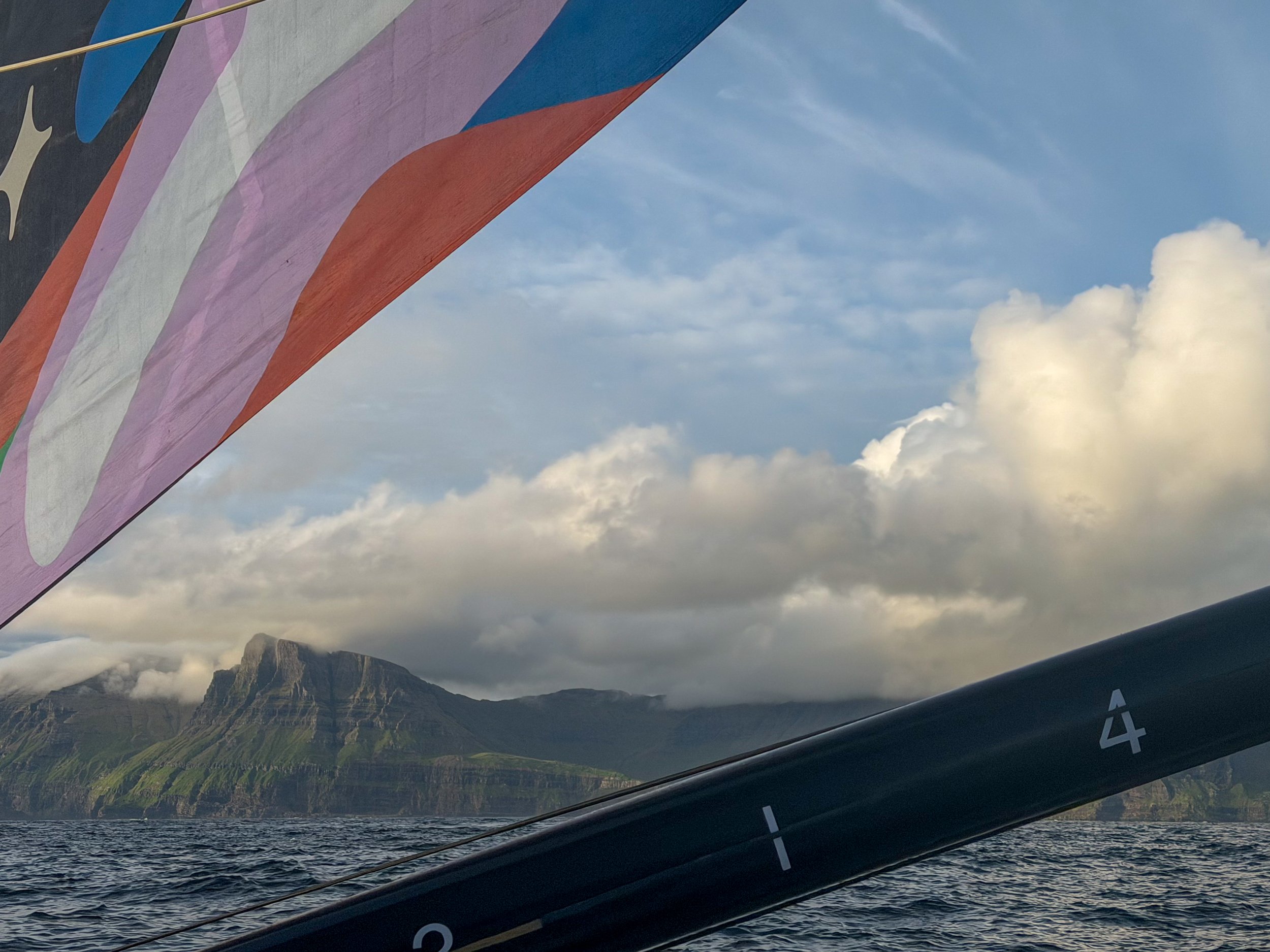
I've been thinking a lot about this out here. Racing to the Arctic Circle, passing through the Faroe Islands, sailing to 66 degrees north, you're surrounded by something enormous and ancient and genuinely wild. It's not the kind of wild you see in a photo - it's the kind that hits you physically. The coldness, the scale of it, the way the light moves at these latitudes. And it's impossible to be out here and not feel the weight of what's at stake.
The coastal plain of the Arctic National Wildlife Refuge is the calving ground for the Porcupine Caribou Herd - hundreds of thousands of animals that have been making that migration since long before any of us existed. It's home to polar bears, musk oxen, migratory birds, and wolves. It's the ancestral homeland of the Gwich'in Nation, people who have been the original stewards of that land for thousands of years and who called an emergency gathering last year because they are watching this threat unfold in real time. Their fight isn't abstract - it's personal, generational, and urgent.
As a POW ambassador, this is exactly the kind of action I signed up to be part of, and not because it's separate from sailing, but because it isn't. The ocean I race on and the Arctic ecosystem are part of the same connected system. What happens in one place ripples into everything else. We're living that reality right now - the warming, the melting, the storms that are becoming something different to what sailors and fishermen used to know. You feel it out here.
So where does this leave us? Three failed lease sales should, in any rational world, be enough to close this chapter for good. But the administration is still pushing forward, which means the fight isn't over. Protect Our Winters and their partners are continuing to push Congress to permanently protect the Arctic Refuge and repeal the mandate requiring future lease sales, monitoring early industrial activity like seismic testing - the kind of work that can leave irreversible damage on fragile permafrost before a single drill goes in - and holding financial institutions accountable for supporting extraction schemes that threaten public lands, Indigenous communities, and wildlife. And calling on all of us to use our voices, because that is genuinely something that moves the needle.
If you want to do more, the POW website has everything you need to learn more. Contact your representatives, sign the petition, and talk about it. You don't have to be racing to the Arctic Circle to care about what happens there - knowing it exists and knowing what could be lost should be more than enough.
Andiamo,
Frankie