
Protecting Marine Mammals: our approach for the Vendée Arctique
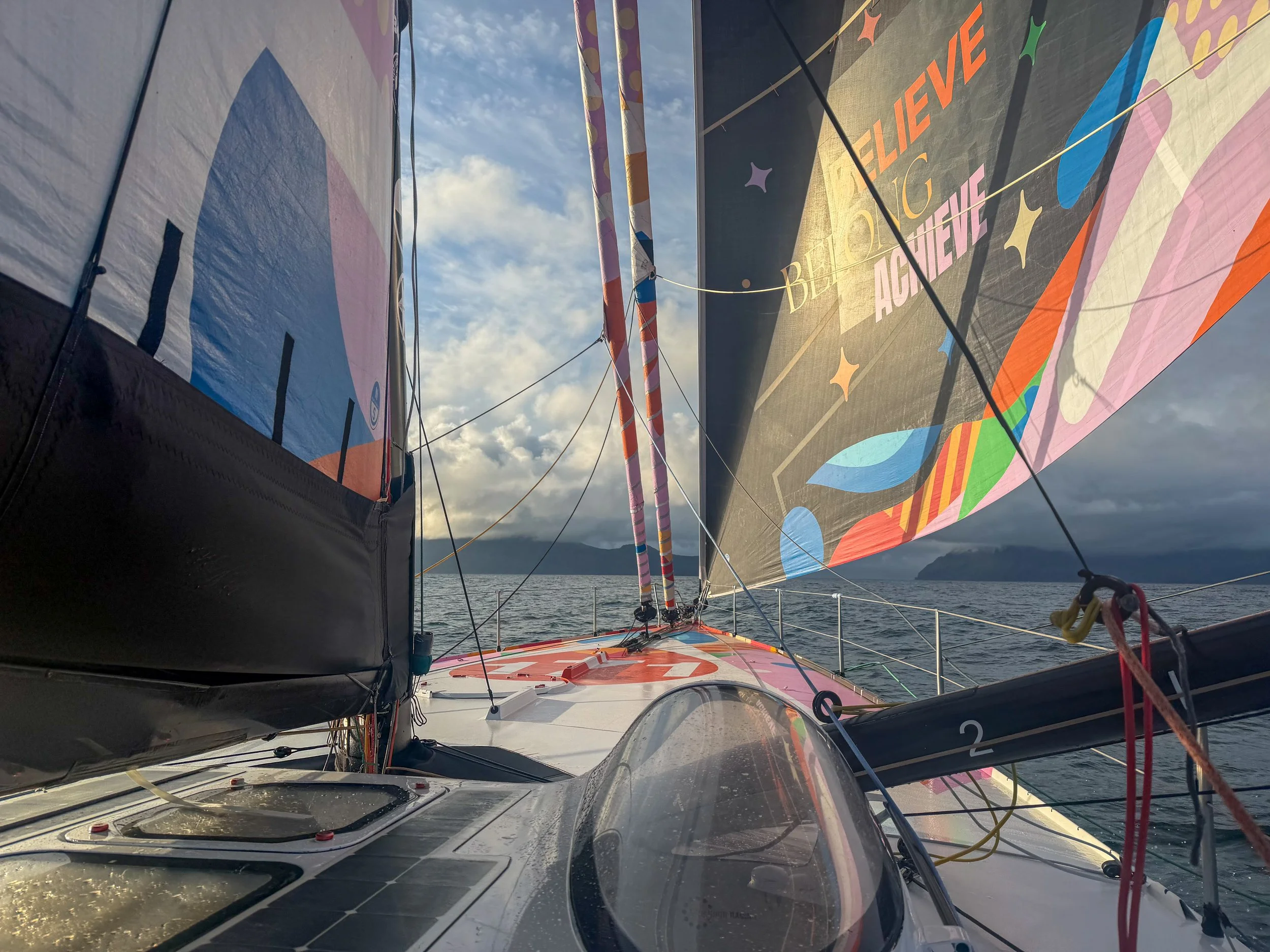
The long read: Communications & Purpose Director, Emily Caroe, takes a deep dive into the team’s protocols for the protection of marine mammals.
The North Atlantic and Arctic waters of the upcoming Vendée Arctique-Les Sables d’Olonne race route are not empty ocean; they are home to some of the world's most significant concentrations of marine mammals - blue whales, humpbacks, fin whales, orcas, and basking sharks, among others. In the days leading up to the race, with the tech team, comms, and purpose team here in Les Sables going through final onboard checks, weather meetings, and media interviews, we are also working to mitigate the risk of marine mammal strikes.
Our approach to this is preparing each time a race-specific Nature Action Plan, using a framework we have developed within the team, based on the event Nature Action Plan from the Marine Mammal Advisory Group and World Sailing's Marine Megafauna in Sailing Guidelines. Our Plan reviews the waters Francesca may race through, identifying the species specifically at risk of collision, it helps the team understand the seasonal behaviors of the marine species she may encounter, where the risks for marine mammal interactions are highest, and ensures all our reporting systems, mitigation systems, and strategies are up to date.
We source our information from global databases including Blue Corridors and the Important Marine Mammal Areas (IMMA) database, from local experts, and information provided by Race Organizers.
Alongside the marine mammal identification charts Francesca has onboard to support reporting of any uncharted hazards, we ensure that she is comfortable with using the onboard equipment, including the Hazard Reporting System integrated into the routing software which shares any potential sightings with other boats in the area. We also ensure our robust reporting system is in place in the event of any incidents. For us it is really important to have this integrated approach with expert scientists, sailors, and race organizers to minimize our impact and actively support citizen science.
We often get asked questions about our marine mammal program so have put together a Q&A with some of the most popular - and challenging - questions that arise.
Q&A: The hard questions on marine mammal safety in offshore racing
What is a Nature Action Plan, and why does Team Frankie prepare one before every race?
Our Nature Action Plan is a pre-race document that maps the marine mammal risk specific to a given race route and season. It draws on scientific databases - including the global Important Marine Mammal Areas (IMMA) registry - as well as expert input from marine scientists, local knowledge, and race organizer data. The output is a briefing that gives Francesca a clear picture of which species she is most likely to encounter, where and when the risk is highest, and what the protocols are if there is an incident.
It is not a box-ticking exercise. It shapes our pre-race preparation and covers the identification charts onboard, how the Hazard Reporting System in our routing software works, and our team's internal incident reporting procedure. We prepare a Nature Action Plan before every offshore race, and have one for the area around our team base in Lorient, France.
We developed our own team Nature Action plan based on the format created by World Sailing in their Marine Megafauna in Sailing Guidelines for race organizers. It’s a simplified version, specifically designed for the training and racing that we do. We are happy to share it with any other team to help them get started as sharing these resources will make it easier for everyone.
What is the Vendée Arctique doing on marine mammal protection?
The Vendée Arctique-Les Sables d’Olonne (VALS) race organization has taken a genuinely thoughtful approach to marine mammal protection and it has been interesting to view their methodology for this race as it is different to other races and events we’ve been part of before.
The VALS have developed their own system in partnership with Pelagis - one of Europe's leading marine mammal research centers, based in La Rochelle - and the Natural History Museum in Paris. Their scientists have modeled marine mammal density using historical observation data combined with behavioral science: understanding, for example the surface time for different species, that blue whales typically travel at 0–0.5m depth, while orcas dive far deeper; and tracking where plankton concentrations go, because prey availability drives where the whales will be. From this, they have calculated collision probability and set thresholds that define where risk is elevated and put in place exclusion zones as part of the Sailing Instructions.
This methodology is aligned with recognized standards to model co-occurence of marine traffic and marine megafauna, and having scientists available at the skippers' briefing to explain the methodology directly is exactly the right approach in supporting a credible mitigation plan for the event.
What is interesting is that the VALS’ data doesn’t include the critical habitats identified as high-priority zones for multiple species along the west coast of Ireland and Scotland by the Important Marine Mammal Areas (IMMA). The IMMA standard exists precisely so that decisions like this are made against a consistent, peer-reviewed scientific baseline.
Conversely, Iceland's waters present a different case: the IMMA database does not yet fully cover that region, which is why additional Arctic-specific scientific work by the VALS team is valuable and appropriate.
Within our team’s Nature Action Plan - combining both the VALS data, along with the IMMA data that we have sourced - we feel confident that Francesca will set off with a good understanding of the areas of higher risk. This, of course, doesn’t mean that a marine mammal strike is guaranteed to be avoided, but our plan, along with the Hazard Reporting System, and onboard technologies such as the OSCAR system, we are doing everything we can to minimize the risk to the mammals, to Francesca, and to the boat.
What’s the Hazard Reporting System and should it be mandatory in race rules?
A short answer - yes! But let’s share a fuller picture of the Hazard Reporting System:
What it is: a feature built into Adrena (and Expedition Marine) navigation software — the routing software used by IMOCA skippers. When a sailor encounters an obstacle (it could be a marine mammal or a container or large tree trunks, for example) or they have a collision, they press the button on the screen and the incident is automatically logged and broadcast to the race director and all other boats in the fleet in real time through the Adrena software. This system is integrated into a Global Hazard Reporting network which includes the Whale Alert network facilitating the exchange of live hazard reporting information across all marine traffic globally.
This information is also collected in the Marine Strike Log, which is now the most comprehensive database of collisions for any marine traffic sector, and directly supports future risk assessments and routing planning.
What it captures: the location, nature, and timing of the hazard. In practice during the 2024 Vendée Globe it detected cetaceans, drifting beacons, abandoned or sunken boats, containers, wood, and unidentified fishing vessels (source).
History: originally developed as a beta for The Ocean Race, it was officially launched for the Transat Jacques Vabre (now The Transat Café L’OR) in October 2023. By that point it was on about a third of the IMOCA fleet (those running the latest software version).
Longer-term tech: Adrena and IMOCA are also developing EXOS - an automatic collision avoidance system using AI vision + multi-sensor fusion that can instruct the autopilot directly. The goal is to have this available for the 2028 Vendée Globe as a mandatory requirement. We are supporting this roll out by testing this onboard and Francesca had it working for the first race of the season.
Interestingly, under IMOCA Class rules, the Hazard Reporting System is not a mandatory requirement. Race organizers can choose to require it, but they are not obligated to. The Vendée Arctique race organizers have told us that they may consider making it mandatory for future editions.
We would like to see this lack of mandatory requirement change. The Hazard Reporting System is a straightforward, low-friction tool that turns every boat into a data point for the benefit of the whole fleet. Requiring it in race rules could prevent collisions. The IMOCA Class has an opportunity to make hazard reporting a baseline requirement for all events held under its rules, which will align with what has become a recognized standard by World Sailing and major offshore events.
If there is a risk of hitting a marine mammal, why do you go sailing?
Particularly when there have been incidents on the water with marine mammals there are always comments aimed at teams and sailors around the danger of sailing with foils:
"You're sailing on boats with large foils - they're like knives through the water. Isn't that irresponsible?"
This is a very real and apt challenge, and it deserves a direct answer rather than deflection.
Modern foiling IMOCAs are fast, they are large, and yes - the appendages are sharp. We are not going to pretend otherwise. A collision at race speed with a whale or basking shark is a serious event, for the animal and potentially for the boat and crew. We saw this with 11th Hour Racing Team during The Ocean Race 2022-23 during the leg from Newport, RI, USA to Aarhus, Denmark.
“So why don’t you just not go sailing, or only race boats without foils?”
Offshore racing sailors are among the most vocal, credible advocates for ocean health precisely because they are out there. Francesca has spent more time in the open ocean than many people. She has seen the impact of climate change firsthand, she cares about it personally, and she has a platform and audience that most marine scientists don't. Removing sailors from the ocean doesn't protect it; it removes some of its most motivated defenders.
If the "don’t create risk" comment becomes the standard, it would then have to apply to all types of shipping - commercial (which has a far higher incident record with marine mammals than racing, although reporting is far lower), fishing fleets, ferry routes, and cruise ships. Offshore racing is a very small contributor to the overall collision problem but due to the nature of our sport, if a strike does happen it can be immediately evident to those who are following the racing.
The question isn't whether humans should be at sea - it's whether everyone operating at sea is doing everything they can to reduce the risk and reporting accurately.
In addition, every race we compete in generates real scientific data - sightings, collision reports, behavioral observations - that feeds back into the research record. Sailors shouldn’t be seen only as a risk to marine mammals; they should also be seen as active contributors to understanding and protecting them.
So the honest answer is that we're not going to pretend offshore racing has zero impact. But "don't go" as a principle would eliminate most human ocean activity, and it would silence some of the loudest voices for ocean protection in the process. The goal is to do it better - and to hold the entire industry, not just sailboat racing, to a higher standard.
So what are you doing as a team to reduce risk?
Because of the risk, we have multiple different things we are doing to reduce our impact on the waters. Races including The Ocean Race and 2024 New York Vendée – Les Sables d'Olonne race have put in place speed reductions in high-risk areas, offshore starts to avoid marine mammal risk, biodiversity protection zones, pre-race education for the sailors, real-time hazard reporting, and post-incident transparency, all of which make a difference. Knowing where mammals are concentrated - and when - gives sailors the context to be more alert, to adjust course if possible, and to report accurately if something happens. That knowledge also feeds back into the scientific record, improving future risk models.
The foils question is also, in part, an argument for the racing world to engage more seriously with boat design considerations in the longer term. We are not there yet as an industry, but the conversation is underway.
What happens if there is a collision during a race?
In European waters, there is a legal obligation to report marine mammal collisions. Most race rules - including for the upcoming VALS - also mandate reporting as part of the Sailing Instructions, and the IMOCA rules are no exception. Our internal protocol within Team Frankie goes further: we have a clear chain of communication to the race organization, the relevant national authorities, and the International Whaling Commission via the Hazard Reporting System which ensures we feed live safety information of any incident or encounter directly into the network and to other vessels, and we have prepared for this scenario as part of our pre-race planning.
In the transatlantic leg of The Ocean Race 2022-23, 11th Hour Racing Team was involved in a collision with a marine megafauna. Our communications and purpose director, Emily Caroe, was the communications director for the team at the time.
“A collision with a marine megafauna was, to be honest, something we dreaded happening, especially as a team that was actively championing positive action and solutions for ocean health. We knew it had to be carefully handled,” shared Emily.
“Prior to the race we had prepared for this scenario, and so when it happened we at least had a baseline to work from. We met with our sponsor, 11th Hour Racing, agreed with them on our honest approach, and shared publicly a very factual statement sharing that we knew we had hit something, that everyone was devastated by it happening - particularly those onboard - and that we would be reporting it to the relevant authorities, which we subsequently did. We also prepared multiple responses to challenging questions which we anticipated may come in either directly, from media, or through social media channels.
“Once we shared the statement, we waited for the comments to roll in and, interestingly, the response from the sailing community and beyond was overwhelmingly positive, of course not because the collision was acceptable, but because our openness was. Transparency clearly matters. There were, of course, some comments from people challenging us on the fact we were racing, that the IMOCAs have coachroofs and keeping a continual watch isn’t possible, that we have foils as appendages, but these comments were, in the large part managed by the community who followed us. Interestingly , I also received a number of emails and calls from other teams and race organizers thanking us for being so open because it paved the way for them to have these open conversations with their sponsors and put in place this type of honest response in their communication planning.
“By being so open with what happened, and following our pre-prepared reporting protocols, this contributed, even in this tragic way, to the scientific record, and it models the behavior we want to see normalized across the sport. Covering up incidents - or treating them as purely private or a damaging crisis that should be hidden - does nothing to improve future outcomes for the marine mammals or the boats.”
What should race organizers be doing that they are not doing yet?
There are three things, specifically we’d like them to focus on:
Use the IMMA standard as a baseline. The Important Marine Mammal Areas database is the internationally recognized scientific benchmark for identifying critical habitats. Any race risk assessment should be checked against it. Additional scientific work can and should supplement it - but it should not replace it or quietly exclude areas it designates as high-priority.
Make hazard reporting mandatory. The Hazard Reporting System, or equivalent real-time reporting tools, should be a requirement in race instructions, not an optional feature. Every sighting or encounter that gets reported improves the data available to scientists and increases the safety of other sailors already at sea.
Be transparent about methodology and be collaborative. Share the source and original report on marine mammal research on request, and justify data sources, along with having a comprehensive approach to including all available datasets from along the race route, aligned with recognized standards. Also ensure that there is close collaboration between races, organizers, authorities, and teams, ensuring that information is available for the widest possible use and for future events.
What can other teams do?
Create a Nature Action Plan. Support the work of the Marine Mammal Advisory Group and follow the protocols from World Sailing’s Marine Mammal Guidelines. Make the creation of a Nature Action Plan before racing a standard protocol, in the same way you’d prepare your crisis plan, or float plan. We are more than happy to share our template plan with other teams.
Lobby race organizers. Speak to race organizers about their marine mammal protocols and ask for briefings before departure, with clear scientific data.
Plan to communicate openly. Every incident adds to the scientific record that researchers use to refine collision risk models - unreported strikes are data gaps that make everyone less safe. A culture of silence poses a far greater reputational risk to a team and to offshore racing as a whole than honest disclosure ever would. The hazard reporting system compiles and anonymizes reports, and with the integration of the Whale Alert system, which provides a free option, there are no barriers to live reporting of hazards sighted or encountered at sea.
What can fans and followers of sailing teams do?
Ask questions. Follow teams and races that are transparent about their marine mammal protocols - and ask questions of those that aren't. Audience pressure moves the needle faster than regulation.
Learn the basics. Understanding what IMMA zones are, why marine mammal hotspots matter, and what races are doing to address collision risk makes you a more informed and more demanding follower of the sport.
Support teams that lead. When teams publish Nature Action Plans, report incidents openly, or publicly push for better race standards, that deserves recognition. Positive reinforcement matters as much as criticism.
Emily Caroe is an ambassador for the Marine Mammal Advisory Group
