
How to qualify for the Vendée Globe… And compete in the IMOCA Globe Series
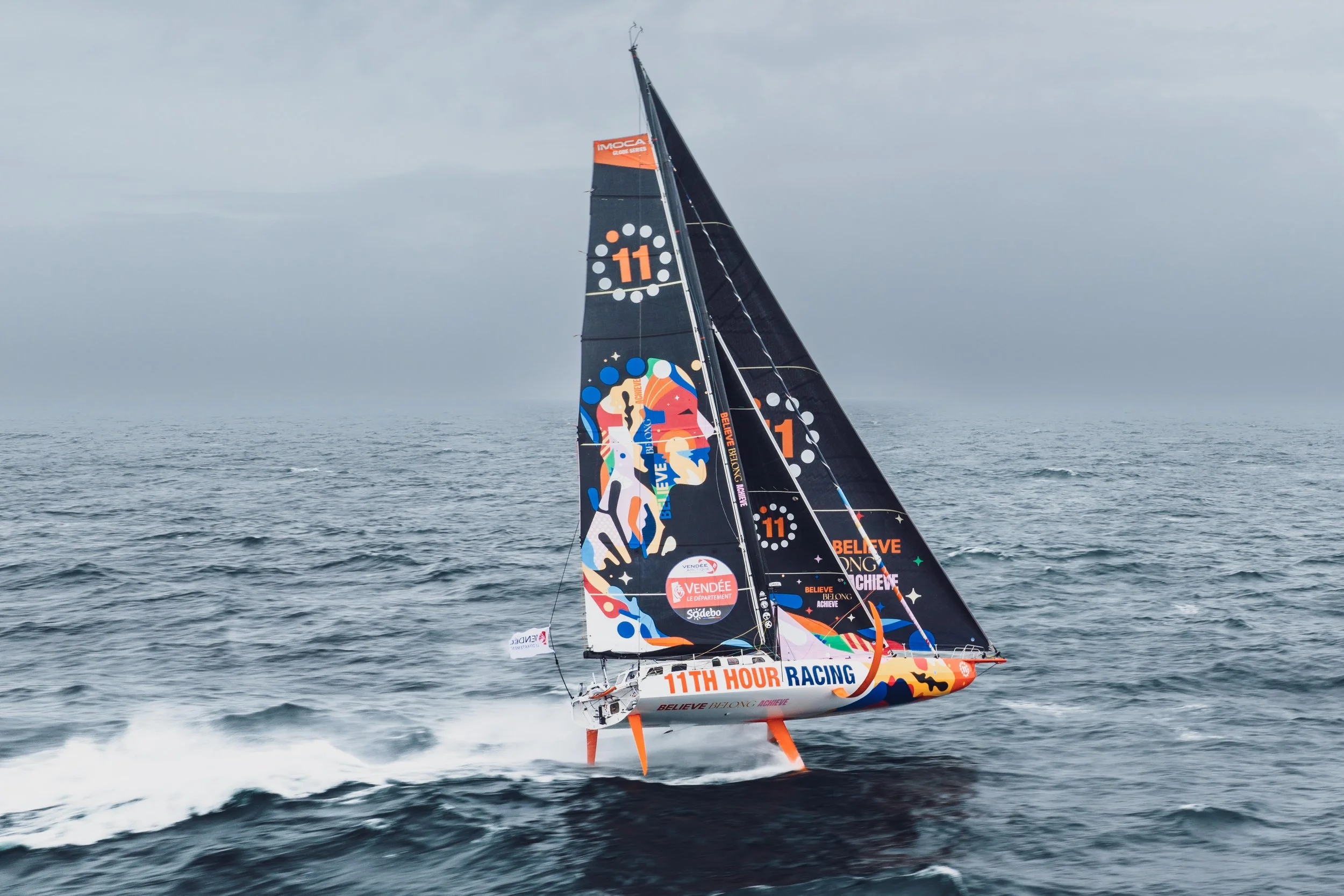
© Marin Le Roux - polaRYSE / 11th Hour Racing
The Vendée Globe has long been a dream of mine - racing solo, non-stop, around the world. It's a race that will demand everything from me and the team: grit, preparation, technical precision, mental strength, and a deep respect for the ocean and my competitors. With our announcement back in February 2025 that, thanks to our sponsorship from 11th Hour Racing, we’ve officially started that journey, we are on our way! And qualifying for the Vendée Globe all begins with the IMOCA Globe Series.
I thought it might be helpful to explain just what the IMOCA Globe Series is all about so here goes … a five minute run down on the World Championships of offshore sailing.
What is the IMOCA Globe Series?
The IMOCA Globe Series is the annual international championship for the IMOCA Class. Over a four-year cycle, leading up to the Vendée Globe, it brings together eighteen races across thirteen countries, sailing either solo or with a crew.
And for the first time ever, this ranking determines who earns their spot on the Vendée Globe start line.
Here’s how it works:
The IMOCA Globe Series runs from 2025 to 2028.
It includes solo, double-handed, and fully crewed races, from solo and shorthanded classics like the Transat Café L’OR (formerly the Transat Jacques Vabre) and the Route du Rhum, to fully crewed round-the-world events like The Ocean Race.
Each race carries a points coefficient, depending on its difficulty and format.
At the end of every year, the IMOCA Globe Series championship title goes to the skipper with the most points for that season.
For the Vendée Globe selection, your overall standing in the IMOCA Globe Series matters, but so does finishing at least one solo race over 1,000 nautical miles within a set time limit (no more than 150% of the winner's time).
The championship rewards consistency, resilience, and versatility. You can't just be fast in one format, you have to perform across the board.
So... how do IMOCA points actually work?
Great question, because honestly, the points system can feel like a maze when you're new to it!
Every race I do between now and the Vendée Globe earns me points. The better result I achieve, the more points I accrue, and each year the sailor with the most points wins the IMOCA Globe Series Championship - a bit like being crowned World Champion for the IMOCA Class. In addition to this, these points stack up over a four-year period for the Vendée Globe qualification.
So how are the points calculated?
Each race has a ‘grade’ that tells you how important it is and how many points are up for grabs. The bigger the race, the more it counts.
Here's the rough breakdown:
Grade 1 (round-the-world races: the Vendée Globe and The Ocean Race)
→ More points. More pressure. More prestige. 400 points for first place, 375 for second, 350 for third …Grade 2 (transatlantics and races more than 2,500nm, like the New York–Vendée or The Transat CIC)
→ These are super important for solo qualification too. 200 points for first, 180 for second, 165 for third …Grade 3 (races between 1,000nm and 2,500nm like the Course des Caps).
→ For Grade 3 events it is 100 points for first, 90 for second, 80 for third …Grade 4 (shorter or more local events)
→ For Grade 4 events it is 50 points for first, 45 for second, 40 for third … Still valuable, especially early in the cycle.
The points system highlights both individual and team performance:
Skipper: earns 100% of the points corresponding to their ranking
Crew members or co-skippers: earn 50% of the main skipper's points
Skipper DNF (Did Not Finish): receives 50% of the points of the last ranked skipper
Each race also has a coefficient - kind of like a multiplier. The higher the coefficient, the more impact it has on your overall ranking. So finishing 5th in a big transatlantic might get you more points than 2nd in a smaller coastal race.
How I plan to qualify for the Vendée Globe
There will be 40 slots on the Vendée Globe startline in Les Sables d’Olonne in November 2028. Here’s what I need to do to earn one of them:
Finish a solo qualifying race
I’ll need to complete one in under 200% of the winner's time to show my capability.Rank in the top 37 of the IMOCA Globe Series at the end of the four-year cycle
Every race I enter between now and 2028 contributes to my cumulative points total. The better I perform, the more likely I am to qualify directly.
Leave room for the unexpected
The rules allow skippers to discard their three worst results over the four-year period. That means if I miss a race, or just have a bad one, it won’t necessarily cost me my spot on the Vendée Globe startline. It also gives space for life, balance, and flexibility.
Why the IMOCA Globe Series matters
The Series gives me more than just a way to qualify for the Vendée Globe. It sharpens every aspect of my sailing:
Crewed and solo formats let me grow as a sailor and a leader.
Sailing around the world with a team, like in The Ocean Race, strengthens the foundation for going solo.
The championship pushes me to bring out my best, race after race.
It also helps tell the story. The Series brings global visibility to our campaign, our values, and our goals, from performance to sustainability to creating space for the next generation.
The road to the Vendée Globe is long, and it should be. Every mile is earned. Every decision matters. But I’m not walking, or sailing, this path alone. With our sponsor, 11th Hour Racing, our partners, our supporters, and the incredible IMOCA community, I’m all in.
So that’s a brief overview of how I plan to qualify for th 2028 Vendée Globe. Join me on my journey!
One boat. One skipper. One planet. One race around the world.
Andiamo!